Wednesday, October 14, 2026
Imam Abu Hanifa (RA) Fifth National and International Expo and Trade Fair held in Kabul, the capital of Afghanistan, with broad participation from traders, industrialists, investors, and representatives of domestic and foreign companies, concluded yesterday after seven days of activities in an official closing ceremony at the exhibition venue.
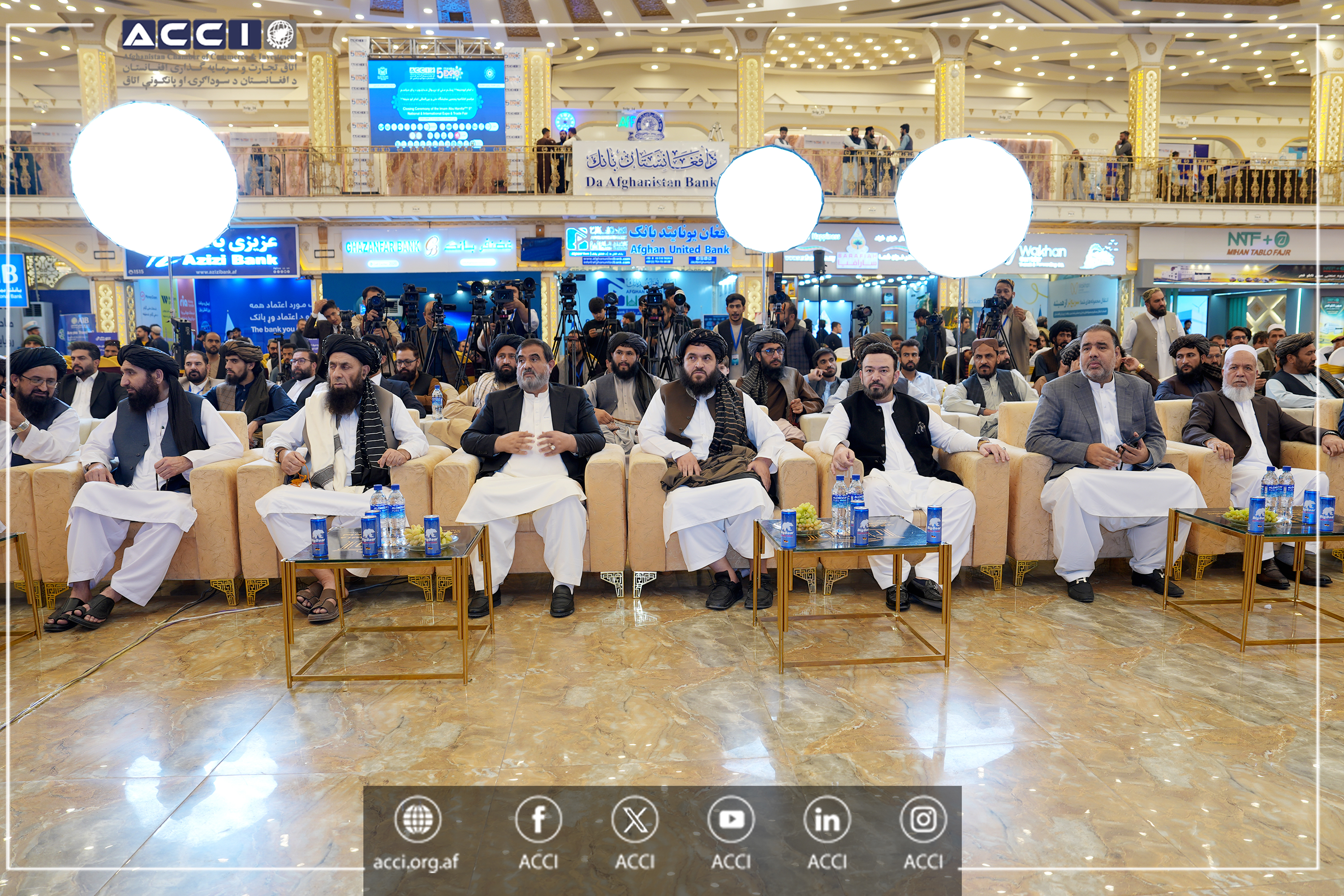
The closing ceremony of this major economic and trade event was attended by officials of the Islamic Emirate of Afghanistan, diplomatic representatives of regional countries, the leadership of the Afghanistan Chamber of Commerce and Investment, officials of economic institutions, private-sector representatives, traders, investors, and exhibitors.
In his address, Mr. Sayed Karim Hashemi, Chairman of ACCI described Imam Abu Hanifa (RA) Fifth Expo as a valuable opportunity to showcase Afghanistan’s economic and production capacities, develop trade relations, expand export markets, and attract domestic and foreign investment.
He stated that, beyond showcasing the country’s products and economic potential, the exhibition had provided a suitable platform for establishing direct connections between Afghan economic actors and foreign business partners, exchanging experiences, and creating new opportunities for cooperation and investment.
Mr. Hashemi highlighted the presence of traders and business representatives from the United States and the Islamic Republic of Iran “under one roof,” as well as speeches delivered by representatives of both sides, as among the exhibition’s significant and noteworthy developments.
He emphasized that their joint presence demonstrated the effective role of trade in bringing nations closer, building mutual trust, and expanding economic cooperation beyond political differences.
The Chairman of ACCI added that, as a non-governmental and non-political institution, the Chamber believes trade relations should be based on mutual respect, shared interests, and economic cooperation. He noted that trade can serve as a bridge for understanding, strengthening economic relations, and fostering constructive ties between nations.
Mr. Hashemi also expressed his appreciation for the participation of traders, investors, and representatives of friendly countries, inviting economic actors from across the region and the world to build on existing capacities and opportunities and expand joint trade and investment cooperation with Afghanistan’s private sector.
Referring to the event’s achievements, he stated that approximately 700 exhibition booths had been dedicated to showcasing the products, services, and economic capacities of domestic and foreign companies over the seven-day event. More than 500 traders, investors, company representatives, and business guests from various countries had also participated.
The Chairman added that, as a result of bilateral business-to-business (B2B) meetings, negotiations, and dedicated meetings among economic actors, trade contracts and memorandums of understanding (MoUs) worth a total of USD 934.8 million had been signed.
Emphasizing the importance of following up on and implementing these agreements, Mr. Hashemi noted that their true value was not limited to the figures recorded but depended on the extent to which they were implemented and their impact on increasing domestic production, expanding exports, creating employment opportunities, and improving people’s economic conditions.
He stated that ACCI would work in coordination with relevant institutions and business partners to facilitate the follow-up and implementation of the agreements reached.
Mr. Hashemi also expressed his appreciation to the leadership of the Islamic Emirate of Afghanistan, particularly Mr. Mullah Abdul Ghani Baradar Akhund, Deputy Prime Minister for Economic Affairs, as well as officials of relevant ministries and institutions, for their cooperation in organizing the exhibition.
The Chairman stressed the need to provide practical facilities for the private sector, remove barriers to trade and investment, establish a healthy and fair competitive environment, support domestic production, and strengthen coordination between government institutions and economic actors.
During the ceremony, Mr. Ahmadullah Zahid, Deputy Minister of Industry and Commerce, referred to the growth of industrial activities in the country, stating that the number of manufacturing factories in Afghanistan had increased from approximately 3,000 to more than 6,000. He emphasized the importance of supporting domestic industries, encouraging investment in production, and creating favorable conditions for the expansion of industrial activities.
Similarly, Mr. Ahmad Jan Bilal, Director General of State-Owned Enterprises, described national and international exhibitions as effective opportunities to showcase economic capacities, expand trade cooperation, and strengthen relations between state-owned enterprises and the private sector. He emphasized the importance of developing joint cooperation to promote industry and strengthen the national economy.
Mr. Alireza Bikdeli, Ambassador of the Islamic Republic of Iran to Afghanistan, also addressed the ceremony, describing the fifth edition of the Imam Abu Hanifa (RA) Expo as more prominent than previous editions in terms of its scale and level of participation. He emphasized the importance of developing economic and trade relations, increasing interaction among economic actors, and expanding joint cooperation between Afghanistan and the Islamic Republic of Iran.
In another part of the ceremony, a representative of the visually impaired community in the northern zone highlighted the capacities and abilities of people with visual disabilities and called for greater attention to their economic participation, the provision of employment opportunities suited to their skills, and support for their effective involvement in economic activities.
Mr. Arian Zalgai Azimi, Deputy for Investment, presented a report on the exhibition’s activities and achievements. He identified bilateral B2B meetings, dedicated meetings between traders and investors, the showcasing of domestic products and production capacities, and the provision of information on investment opportunities as among the event’s most important programs.
He further stated that, according to the organizers’ estimates, the exhibition had attracted approximately one million visitors over seven days, reflecting the strong interest and participation of the public, traders, and other visitors in this economic and trade event.
At the conclusion of the ceremony, certificates of appreciation and gifts were presented to a number of institutions, companies, distinguished individuals, exhibitors, and organizers in recognition of their contributions.
ACCI also expressed its gratitude to government institutions, security forces, traffic authorities, firefighting services, healthcare providers, municipal services, media organizations, exhibitors, and all those who contributed to the organization, security, media coverage, and successful implementation of the exhibition.
Imam Abu Hanifa (RA) Fifth National and International Expo was organized to showcase domestic production, promote Afghan products, develop trade relations, establish direct connections among economic actors, present investment opportunities, and strengthen economic cooperation at the national, regional, and international levels.
The exhibition concluded after providing a platform for direct meetings and discussions between domestic and foreign traders, showcasing production capacities, and creating new opportunities for trade cooperation. Following up on the agreements reached and turning identified opportunities into practical and sustainable partnerships remains a key priority in the aftermath of the event.