Saturday, August 22nd, 2026
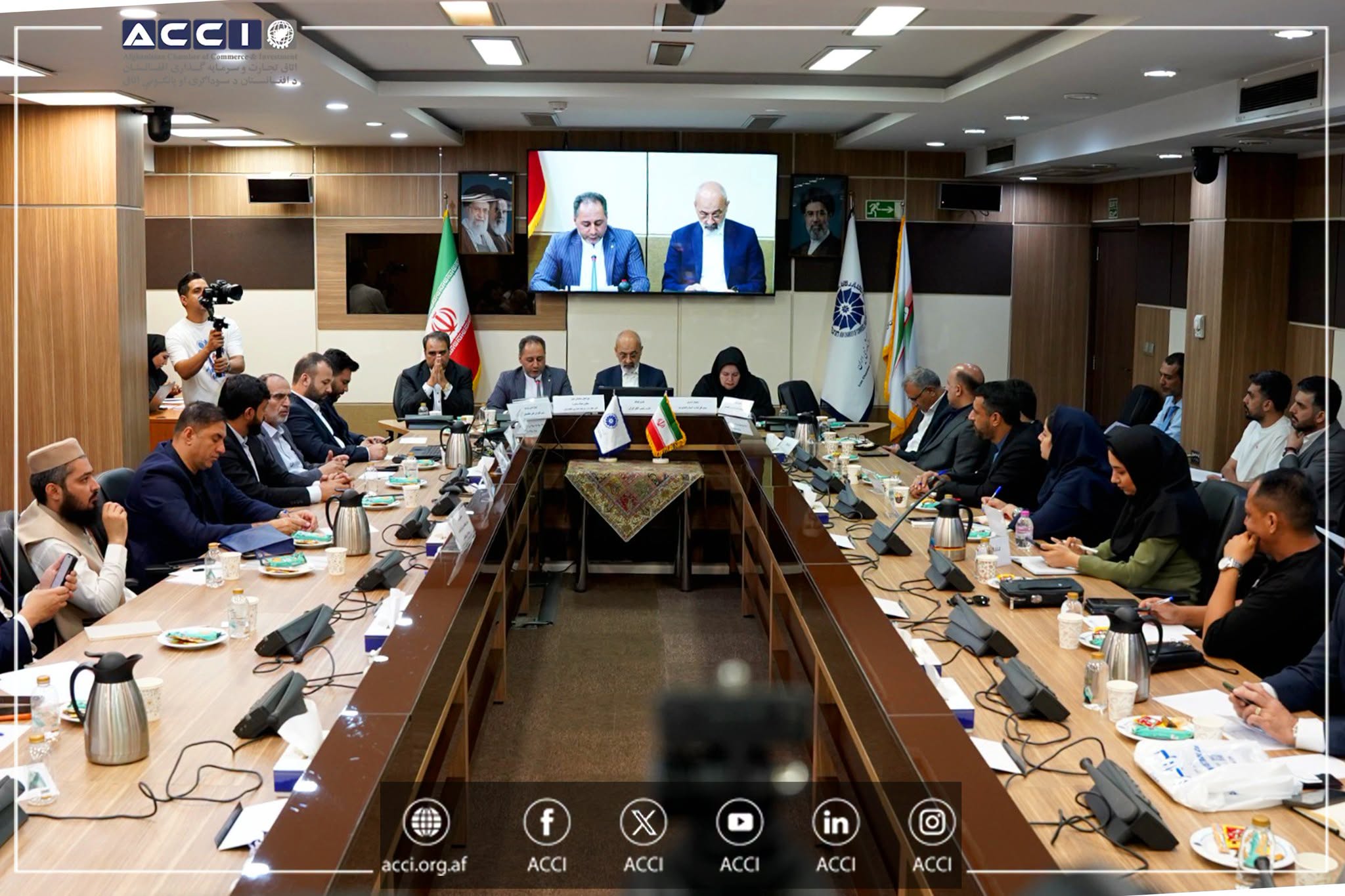
A business meeting between the private sectors of Afghanistan and Iran was held at the main office of the Iran Chamber of Commerce, Industries, Mines and Agriculture, with the participation of a delegation from the Afghanistan Chamber of Commerce and Investment (ACCI), officials from the Iran Chamber, and a number of economic and business representatives from both countries.
At the beginning of the meeting, Mr. Qadir Qiafeh, Deputy Head of the Iran Chamber of Commerce, Industries, Mines and Agriculture, welcomed the ACCI delegation and emphasized the need to expand economic relations between the two countries and move beyond commodity-based trade toward joint investment. He stated that the current trade volume between Afghanistan and Iran is approximately $3 billion, adding that, looking ahead over a three- to five-year period, this figure could at least double.
Mr. Qiafeh, referring to the existing potential in mining, industry, infrastructure, and technical and engineering services, emphasized the establishment of joint working groups between the private sectors of the two countries. He proposed developing a five- and ten-year roadmap for economic, trade, mining, industrial, and infrastructure cooperation between Afghanistan and Iran. He also described joint investment and the use of the complementary capacities of the two countries as among the best ways to achieve sustainable economic relations.
Subsequently, Mr. Mirajan Sulaimankhel, Deputy for Policy and Government Relations of the Afghanistan Chamber of Commerce and Investment, expressed appreciation for the hospitality extended by the Iran Chamber and the Iran-Afghanistan Joint Chamber. He stated that this was the first official business delegation from ACCI to the Islamic Republic of Iran in the past year and that the visit was taking place at a time when regional economic developments had created new opportunities for expanding cooperation between the two countries.
He emphasized that Afghanistan and Iran should move beyond traditional trade toward joint investment, joint production, technology transfer, and the creation of shared value chains. According to him, mining, energy, infrastructure, transportation, logistics, technical and engineering services, and food industries are among the most important areas for cooperation between the two countries.
In the mining sector, Mr. Sulaimankhel proposed cooperation in mineral exploration and extraction, as well as the transfer of technical knowledge and technology, emphasizing the creation of added value inside Afghanistan. He also described connecting the mining and industrial value chains of the two countries, particularly in the iron and steel sector, as an important opportunity for expanding production and gaining joint access to regional markets.
He further referred to Afghanistan's need for sustainable energy and identified the use of Afghanistan's coal reserves, cooperation with Iranian companies in power plant construction, and the transfer of technical expertise as important areas of cooperation. The meeting also emphasized expanding cooperation in transportation, making effective use of the TIR system, facilitating the movement of transit shipments, and avoiding repeated inspections.
Referring to the importance of Chabahar Port and Iran's transit routes, Mr. Sulaimankhel stated that these routes should go beyond merely serving as corridors for the movement of goods and should be transformed into genuine economic corridors offering logistics, warehousing, and other necessary services. He also invited Iranian investors and companies to make long-term investments in Afghanistan's mining, logistics, technical and engineering services, energy, and food industries.
To achieve practical results, the Deputy for Policy and Government Relations of ACCI proposed establishing a joint committee and working group, developing a practical roadmap identifying priority sectors, holding regular business meetings, and creating a joint database. He also called for joint training programs on the TIR Convention, business management, and the transfer of technical knowledge.
He further invited the leadership of the Iran Chamber, as well as Iranian traders and investors, to participate in the Imam Abu Hanifa (RA) Exhibition and Business Forum, which is scheduled to be held in Kabul.
During the meeting, Mr. Moein Khawafi, Commercial Attaché of the Islamic Emirate of Afghanistan in Iran, referred to the target of increasing annual trade between Afghanistan and Iran to $10 billion. He emphasized that existing capacities, Afghanistan's access to international waters through Iran, and the development of railway corridors could help achieve this goal. He also stressed the need to establish an effective mechanism for addressing traders' challenges and expanding economic cooperation between the two countries.
Subsequently, Mr. Hamidullah Habibi, Member of the ACCI Board of Directors, provided information on investment opportunities in energy, construction, transportation, mining, and infrastructure, and invited Iranian companies to invest and engage in joint production in Afghanistan.
Mr. Zabihullah Samim then emphasized expanding cooperation in information technology, artificial intelligence, telecommunications, and the digitalization of services, and called for the participation and cooperation of Iranian companies in these sectors.
Mr. Mohammad Khalid Majid also referred to Afghanistan's extensive iron and oil reserves and called on Iranian companies to invest in the exploration, extraction, and processing of mineral resources.
At the conclusion, Mr. Mahmoud Siadat, Head of the Iran-Afghanistan Joint Chamber of Commerce, emphasized the extensive potential of the Afghan market and the importance of utilizing existing opportunities to expand Iran's economic presence in Afghanistan. He called for improved border management, support for the export of technical and engineering services, and the establishment of mechanisms to remove trade barriers between the two countries.
Mr. Kamaluddin Tawhid, Member of the ACCI Board of Directors, also provided information on investment opportunities in Afghanistan and invited Iranian companies to invest in the country.
During the meeting, various issues, including cooperation in infrastructure, mining, transportation, food industries, information technology, telecommunications, and digital transformation, were discussed. A number of Iranian officials and business representatives also expressed their readiness to expand cooperation with Afghanistan's private sector.
At the end of the meeting, a B2B session between Afghan and Iranian traders and economic representatives was held, during which several positive agreements were reached between companies, particularly in the construction sector.