Sunday, August 16th, 2026
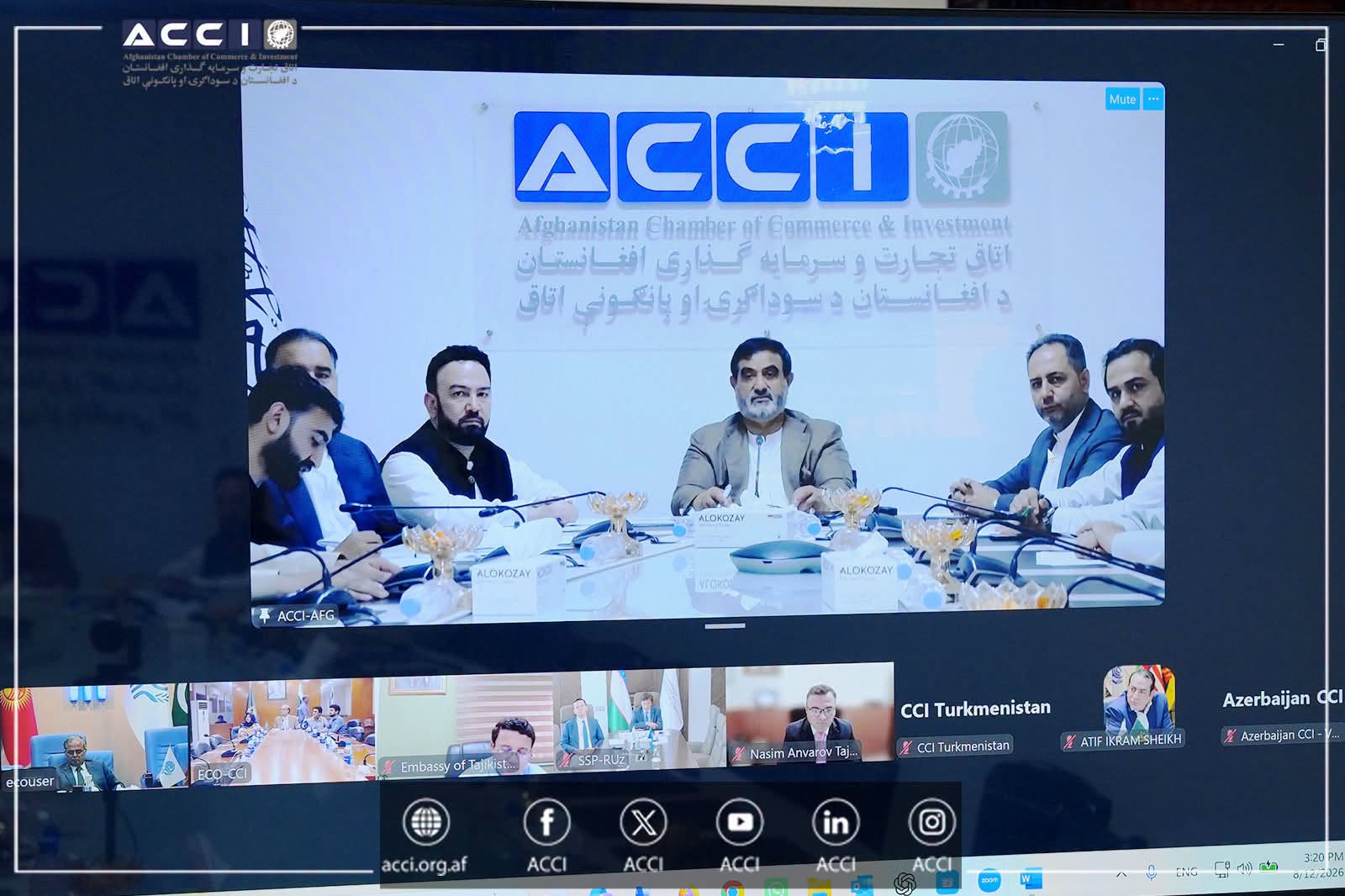
An online meeting of the Economic Cooperation Organization (ECO), aimed at strengthening and expanding regional economic, trade, and transit cooperation, was held with the participation of the heads and representatives of the Chambers of Commerce and Industries of ECO member states.
The meeting opened with introductory remarks by Mr. Atif Ikram Sheikh, Chairman of the Chambers of Commerce and Industries of ECO member states. Subsequently, the heads and representatives of the member chambers discussed ways to expand trade, investment, transit, and regional economic cooperation.
Mr. Sayed Karim Hashemi, Chairman of the Afghanistan Chamber of Commerce and Investment (ACCI), speaking on behalf of Afghanistan’s private sector and business community, described the ECO region as possessing significant economic potential, a strategic geographic location, considerable natural resources, broad markets, and a young and dynamic workforce. He emphasized that the economic future of the region is more than ever dependent on regional cooperation, connectivity, and mutual trust.
Mr. Hashemi stated that, given the rapid transformation of the global economy, changes in supply chains, the growing importance of transit routes, food and energy security, the development of the digital economy, and the need to access new markets, regional cooperation is no longer merely an option but has become an economic necessity.
The Chairman of ACCI emphasized that ECO has the potential to increasingly develop into an effective regional platform for trade, transit, investment, and joint production, with the private sectors of member states playing a fundamental and decisive role in this process.
He described the Chambers of Commerce of ECO member states as effective bridges between governments and the private sector and called for ECO’s economic objectives and decisions to move beyond dialogue toward practical, implementable, and results-oriented programs.
Afghanistan: A Bridge for Regional Economic Connectivity
Mr. Sayed Karim Hashemi, referring to Afghanistan’s geographic position at the crossroads of Central Asia, South Asia, and West Asia, stated that this position should be transformed from a potential geographic capacity into a practical economic and transit advantage for the entire region.
He emphasized that Afghanistan is ready to play a constructive role as a trade and transit bridge among regional countries. The development of transit corridors, facilitation of regional trade, connectivity of transportation and energy networks, and establishment of reliable routes for the movement of goods can bring significant economic benefits not only to Afghanistan but to all ECO member states.
The Chairman of ACCI added that Afghanistan wants regional countries to gain access to new markets through Afghanistan, while the country itself should become an active part of regional value chains and economic cooperation, beyond merely serving as a transit route.
Afghanistan’s Proposals for Expanding Economic Cooperation:
In his remarks, the Chairman of ACCI presented several practical areas for strengthening cooperation among ECO member states.
He emphasized the facilitation of regional trade and transit, reduction of unnecessary barriers, simplification of customs procedures, greater regulatory coordination, and wider use of digital systems.
Strengthening direct connections among the private sectors of member states through regular B2B meetings, joint exhibitions, exchanges of business delegations, and the establishment of an effective mechanism for sharing investment opportunities were also among the proposals presented.
Mr. Hashemi further called for promoting joint regional investments in agriculture and agro-processing, mining, energy, transportation and logistics, textiles, industrial production, technology, and the digital economy.
He also emphasized strengthening the role of small and medium-sized enterprises and creating opportunities for greater participation of business communities in regional trade.
Another proposal by the Chairman of ACCI was the establishment of a systematic mechanism to identify and address trade barriers among member states, allowing Chambers of Commerce to collect the actual challenges faced by traders and present them, together with specific solutions, to governments and relevant institutions.
The Chairman of ACCI also emphasized that ECO’s meetings and specialized committees should become increasingly results-oriented, with clear objectives, timelines, and follow-up mechanisms established for decisions taken.
He noted that the success of regional economic cooperation should not be measured solely by the number of meetings held; rather, actual growth in trade, investment, regional connectivity, and cooperation among member states should serve as the primary measures of success.
Emphasis on Increasing Intra-Regional Trade:
Mr. Sayed Karim Hashemi identified increased intra-regional trade among ECO member states as an important priority and expressed the readiness of Afghanistan’s private sector to expand trade, investment, transit, and joint-production cooperation with all member states.
He emphasized that the economic prosperity of any country in the region cannot be defined separately from the economic prosperity of its neighbors. If the trade routes of member states become interconnected, barriers to the movement of goods and capital are reduced, and investor confidence is strengthened, ECO countries will be able to build a stronger and more competitive economic region.
Emphasizing the need to move from geographic proximity toward economic integration, the Chairman of ACCI called for a shift from limited bilateral trade toward regional value chains and from general dialogue toward tangible economic projects and results.
Emphasis on Resuming In-Person Meetings:
During the meeting, Mr. Atif Ikram Sheikh emphasized the important role of regional economic cooperation and identified the political and military conflicts in the region as among the factors that had reduced regular in-person meetings in recent years.
He stressed the need to resume face-to-face meetings and direct interactions among members and encouraged the organization’s members, in coordination with their respective governments, to facilitate travel, expand B2B meetings among traders and investors, develop and coordinate transportation and logistics networks, and regularly organize meetings among the leadership of chambers and economic institutions of member states.
Afghanistan Ready to Host the Next ECO Meeting:
At the conclusion of the meeting, the issue of selecting the host for the next in-person meeting was discussed.
Mr. Sayed Karim Hashemi, Chairman of the Afghanistan Chamber of Commerce and Investment, on behalf of Afghanistan’s private sector, invited the heads and leadership of the Chambers of Commerce of ECO member states and announced Afghanistan’s and ACCI’s readiness to host the next in-person meeting in Kabul.
The proposal was welcomed by the participants, while Afghanistan’s readiness to host the upcoming meeting was also welcomed by the organization’s leadership and representatives of several member states.
The meeting was also attended by Mr. Mirajan Sulaimankhel, Deputy for Policy and Government Relations; Mr. Arian Zalgai Azimi, Deputy for Investment; and Mr. Faiz Ahmad Khawafi, Deputy for Provincial Affairs of the Afghanistan Chamber of Commerce and Investment.
The next meeting of the Economic Cooperation Organization (ECO) is scheduled to be held in November of this year.
Holding the meeting in Kabul could provide an important opportunity for the direct participation and interaction of the leadership of chambers from member states, the presentation of Afghanistan’s economic capacities and investment opportunities, and practical discussions on trade, transit, investment, regional connectivity, and the expansion of direct relations among the private sectors of member states.
The Afghanistan Chamber of Commerce and Investment considers hosting this meeting an important step toward strengthening Afghanistan’s economic position in the region, introducing the country as an economic and transit connectivity bridge, and expanding trade and investment relations with ECO member states.