Friday, August 8th, 2026
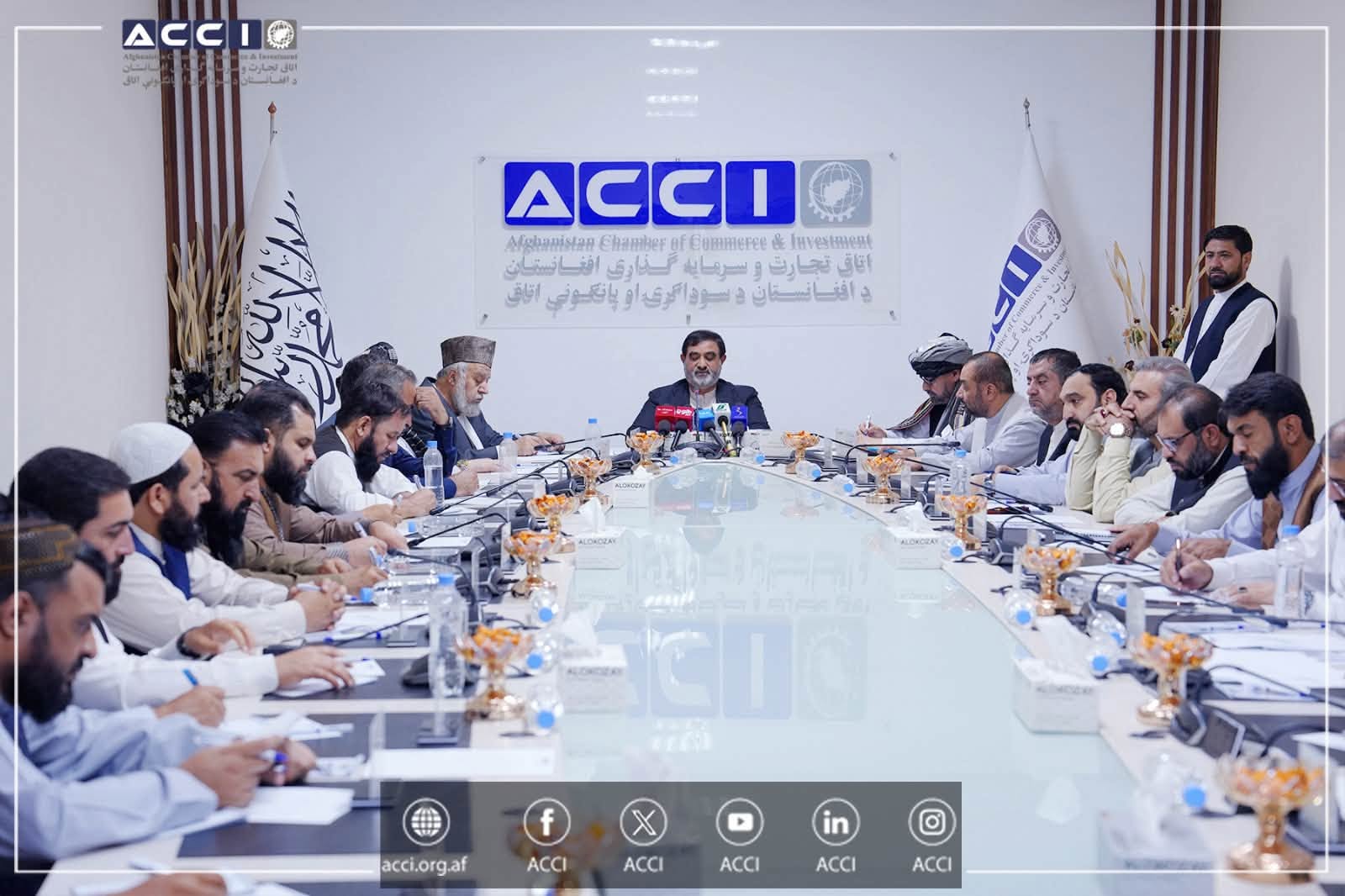
The second “Think Tank” session of the Afghanistan Chamber of Commerce and Investment (ACCI), held under the theme “Strong Economy, Prosperous Afghanistan” was convened at the main office of ACCI, with the participation of university professors, economists, academic and technical experts, advisors, and members of the Chamber’s leadership.
The session aimed to examine the country’s economic challenges, draw on academic and technical perspectives, and develop practical solutions for increasing production, expanding investment, boosting exports, creating employment opportunities, and achieving economic self-sufficiency in Afghanistan.
At the beginning of the session, Mr. Sayed Karim Hashemi, Chairman of the Afghanistan Chamber of Commerce and Investment, welcomed the participants and expressed his appreciation to the country’s professors, economists, and experts for their responsible participation.
He emphasized that Afghanistan, under the current circumstances, needs scientific thinking, practical solutions, and sincere cooperation among the government, private sector, and academic community more than ever.
The Chairman stated that natural resources alone cannot guarantee economic development and prosperity. Rather, sound planning, effective management, and the efficient utilization of national capacities are among the fundamental factors for the country’s sustainable development and progress.
Mr. Sayed Karim Hashemi added that the purpose of the Think Tank sessions is not merely to exchange views. Rather, the Chamber seeks to utilize the knowledge, experience, and expertise of the country’s professionals to develop a comprehensive economic roadmap and strategy, which will be presented as a national proposal to the leadership of the Islamic Emirate of Afghanistan.
He noted that the proposed solutions must be practical, implementable, and aligned with Afghanistan’s realities, while creating opportunities to reduce poverty, generate employment, strengthen investment, increase domestic production, expand exports, and reduce economic dependency.
The Chairman also highlighted Afghanistan’s extensive economic potential, including its natural resources and minerals, fertile agricultural land, strategic transit position, young workforce, and investment opportunities. He stated that effective utilization of these capacities, through sound planning and constructive cooperation between the government and private sector, could help pave the way toward achieving the vision of “Strong Economy, Prosperous Afghanistan.”
He called on the participating professors, economists, and specialists to present their views and practical recommendations with responsibility, dedication, and a national perspective. The Chairman assured participants that their recommendations would be systematically collected and compiled into a comprehensive and specialized document to be submitted to the relevant authorities of the Islamic Emirate of Afghanistan.
Subsequently, Dr. Ahmad Khosrow Zia, Advisor to the Afghanistan Chamber of Commerce and Investment, briefly explained the structure and objectives of the Think Tank and emphasized the need for greater coordination between the government and private sector, as well as the institutionalization of the Chamber’s academic and expert activities.
Mr. Azrakhsh Hafezi, Advisor to the Chamber, also emphasized the establishment of a coordinated framework for identifying shared priorities and solutions between the government and private sector and called on professors and experts to submit their academic and technical recommendations in writing.
The participating professors, economists, and experts shared their views and recommendations regarding the country’s economic challenges and expressed their readiness to provide academic and technical support in developing practical economic programs.
Participants emphasized the importance of utilizing the academic and research capacities of universities and research institutions and strengthening cooperation among the academic community, private sector, and relevant authorities.
At the conclusion of the session, appreciation was expressed for the participants’ presence and academic contributions, while the continuation of Think Tank sessions, compilation of specialized recommendations, and follow-up on their outcomes were emphasized.
The session represents an important step toward strengthening cooperation among academic experts, economic stakeholders, and relevant institutions, while creating a foundation for developing effective economic solutions aimed at achieving a strong economy and a prosperous Afghanistan.